
Healthcare compliance was a design constraint, not an afterthought.
OneFirewall does not yet have a hospital network or health system it can publicly name as an alliance member. We'd rather say that plainly than dress up a gap. What we can say is that the underlying platform was engineered to operate within healthcare's compliance boundaries from early on, and the same mechanics already protecting telecoms, finance, and defence members apply directly to a hospital's perimeter.
The pressure to pay is the point of the attack
- Ransomware against patient care, not just data. Attackers increasingly target clinical and records systems specifically because disruption to patient care creates pressure to pay that a typical corporate ransomware incident doesn't carry.
- Medical devices that can't be patched like a laptop. Imaging, monitoring, and clinical equipment often run on fixed software for years and can't accept the same agents or patch cadence as a standard endpoint.
- IT fragmented across sites. Hospital trusts and health networks typically span many physical sites with inconsistent tooling. That's exactly the setting where a threat seen at one site stays invisible to the rest.
- Security teams sized for compliance, not threat hunting. Many health IT teams are built to pass audits, not to run a full threat-intelligence program. That's a resourcing gap an alliance model is built to close, not a reason to sit out intelligence sharing.
Anonymisation and zero-trust, not raw data pooling
OneFirewall's federated model is explicitly designed to operate "within GDPR, HIPAA, and similar compliance boundaries," using anonymisation and zero-trust principles rather than pooling raw organisational data. For healthcare specifically, that means a hospital network can contribute to and draw from the alliance's shared intelligence without exposing patient-adjacent systems or data to other members.
An honest answer, not a sales pitch
We're actively building presence in healthcare and don't have a named success story to point to yet in this sector specifically. What we do have is a platform built to the same compliance boundaries healthcare already has to meet, a deployment model that keeps data on-site when required, and 290+ members' worth of threat intelligence that doesn't care which industry reported an indicator first.
Deployment that matches clinical-IT constraints
- On-prem, private cloud, or public cloud. OneFirewall Server runs as a single instance in whichever environment a health system's data-governance policy requires.
- Multi-tenant separation of duties. Each organisation's users, feeds, crime scores, and configurations stay logically separated — a fit for trusts or networks managing multiple sites under one security function.
- Fits existing firewalls and WAFs. The WCF Agent pushes blocking into Check Point, Fortinet, Sophos, pfSense, and cloud WAFs already deployed — no forklift replacement of clinical-network infrastructure.
Short answers, because your week is already full
We don't have a SOC. Can a small IT team actually run this?
Yes — that's the point of the alliance model. The WCF Agent pushes already-validated blocking rules automatically; there's no manual playbook to write or threat-hunting program to staff before it's useful.
Does patient data ever leave our network?
No. OneFirewall Server can run on-prem or in a private cloud you control, and the federated model is built to operate within GDPR, HIPAA, and similar compliance boundaries using anonymisation rather than raw data pooling.
Our imaging and monitoring equipment can't take new agents — does that block us?
No. Enforcement happens at the firewall and WAF layer the WCF Agent connects to, not on the devices themselves, so equipment that can't accept new software is still covered as long as its network traffic passes through a protected perimeter.
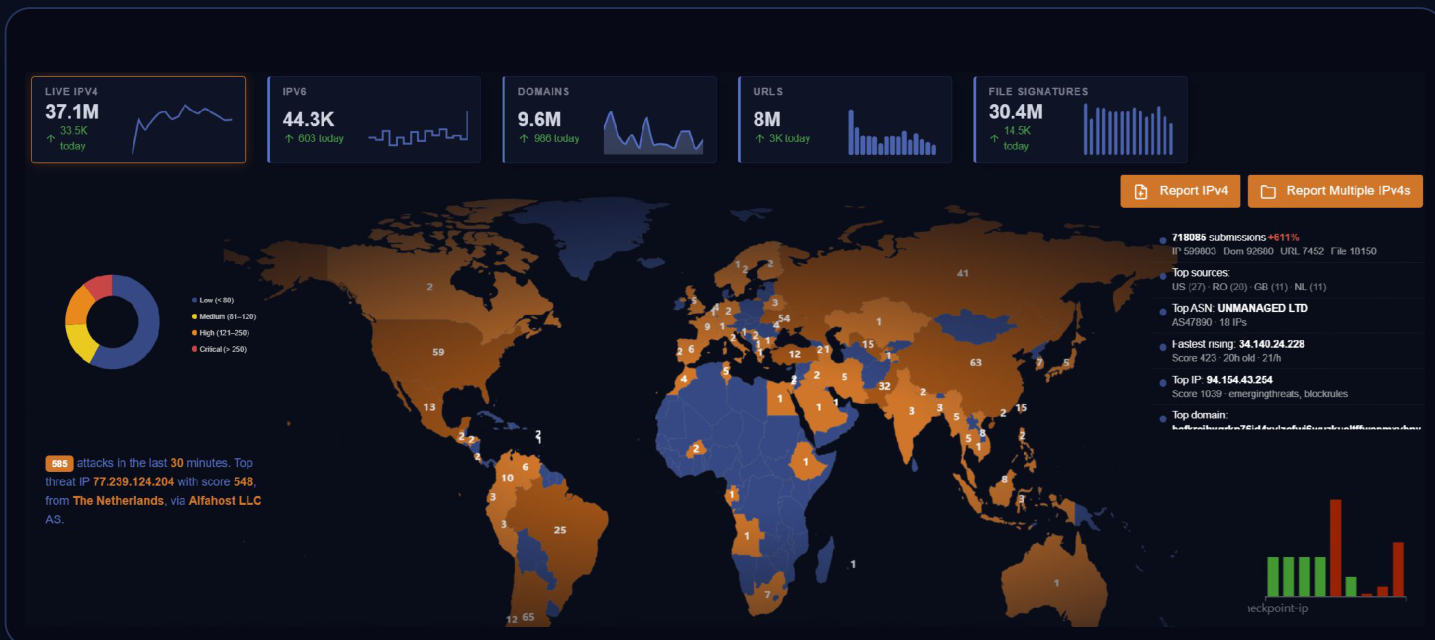
Medical devices, imaging systems, and clinical IoT drew immediate automated probing
In one 8.75-hour honeypot window, scanners reached every major healthcare-relevant protocol without being invited. None required authentication to access the service — that's the point.