
35,000 daily attacks, eliminated in 24 hours — without replacing a single tool.
A global B2B SaaS platform running across Azure, DigitalOcean, and GCP deployed OneFirewall and eliminated all unauthorised traffic reaching its perimeter, including 35,000 daily attacks, while cutting latency 28%. It's a real, published alliance case study — not a projection.
The attack surface is the product
- Dependency-chain targeting. SaaS and platform vendors are increasingly used as a path into their own customers. A compromise upstream becomes a compromise for everyone downstream.
- Multi-cloud sprawl. Running across multiple cloud providers, as the case study above did across Azure, DigitalOcean, and GCP, outruns what any single provider's native security tooling was built to cover consistently.
- API-first attack surface. Developer and API endpoints are now as much a target as the login page, and bot/scraper traffic competes directly with paying users for the same infrastructure.
- Growth outpaces security headcount. Technology companies scale infrastructure faster than they scale security teams, which is exactly where automated, alliance-sourced blocking reduces manual load.
Cloud infrastructure and software vendors show up in the same correlation
A documented alliance case tracked a single malicious IP address independently reported by members across automotive, logistics, cybersecurity, financial services, cloud infrastructure, software development, and GenAI security — across five countries. Evaluated alone, each sighting looked like routine scanning. Correlated across the alliance, it was a single actor systematically working through unrelated technology and infrastructure targets.
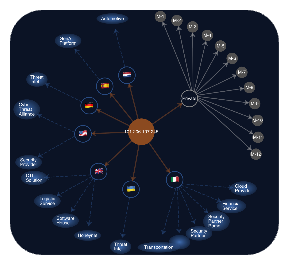
Olidata, AlmavivA, and Telepass
A systems integrator, a mobility-payments operator, and a technology services company, three very different businesses with one thing in common: all three sit in the same intelligence pool as the B2B SaaS platform in the case study above, and all three have skin in keeping it current.



Consistent enforcement across every cloud you run
- 166+ integrations across firewall, cloud, endpoint and SIEM. One feed pushed consistently into Check Point, Fortinet, cloud WAFs, and the SIEM/SOAR stack already in place, across every cloud provider in use, not just one.
- Federated XDR coordination. Coordinated response instructions flow across firewalls, endpoint security, and cloud providers from a single alliance signal, instead of each cloud detecting the same thing in isolation.
- No forklift replacement. The published case study ran on Cloudflare's free tier beforehand, with no advanced DDoS protection. OneFirewall layered enforcement on top of it rather than replacing it.
Why AquilaX 
OneFirewall protects the perimeter your application runs behind. AquilaX protects the code and cloud configuration before it ever ships. Together, that's coverage from commit to production traffic — not one layer with a gap above or below it.
32 Scanners, One Platform
AquilaX runs SAST, SCA, DAST, secrets detection, container, IaC, API, malware, PII, and compliance scanning across 32 scanners in a single AI-driven platform — instead of stitching together half a dozen point tools.
93% Fewer False Positives
AquilaX's own published figure for its AI-driven triage — the difference between a finding list your engineers actually act on and one they learn to ignore.
A Real, Named Relationship
AquilaX lists OneFirewall among the companies it works with, backed by the NVIDIA Inception Program and Microsoft for Startups. This isn't a logo-swap partnership — it's two platforms with overlapping customers and a genuine reason to integrate.
Before this goes anywhere near a sprint
We already run Snyk/Semgrep/Dependabot — why add another scanner?
You don't have to. AquilaX and OneFirewall aren't sold as a mandatory bundle — the point of this page is that code-layer and network-layer coverage are two different problems, and each team can adopt either independently of the other.
We ship multiple times a day. Won't security slow that down?
That's specifically what the 93% false-positive reduction is for — most of the CI/CD slowdown from security scanning comes from triaging noise, not from the scan itself.
Do we need to standardise on one cloud provider to use this?
No. The published case study on this page ran across Azure, DigitalOcean, and GCP simultaneously — 166+ integrations are built to span whatever mix of clouds you already run.
Every exposed management port drew immediate automated probing — containers, AI APIs, and vector databases included
Technology companies expose exactly the infrastructure attackers scan for. In 8.75 hours: container escape attempts, Kubernetes node exploitation, Docker registry enumeration, AI API key probing, and artifact repository disclosure.